- About the project
The project “Unmute Democracy” is carried out in collaboration with VouliWatch and looks into the citizens’ stances towards the functioning of democracy in Greece today, recording both their perceptions of the main threats as well as their evaluations of potential institutional checks and balances, and also forms of political participation that could improve the quality of the democratic political system and strengthen citizens’ engagement in public affairs.
The research is based on a public opinion questionnaire that examines: (a) the evaluation of the way that democracy functions, (b) the threats that democracy is currently facing, (c) the pathologies of political parties, (d) attitudes towards electoral systems and forms of governance, (e) citizens’ willingness to participate politically at different levels, and (f) support for or opposition to institutional interventions concerning transparency, accountability, and the oversight of power.
- Research material
- Identity
The research project was launched in September 2025 and focuses on the study of the quality of democracy in Greece.
Project Coordinator: Dr Antonis Galanopoulos, PhD in Political Science, Aristotle University of Thessaloniki (a.galanopoulos@eteron.org).
- Contributors
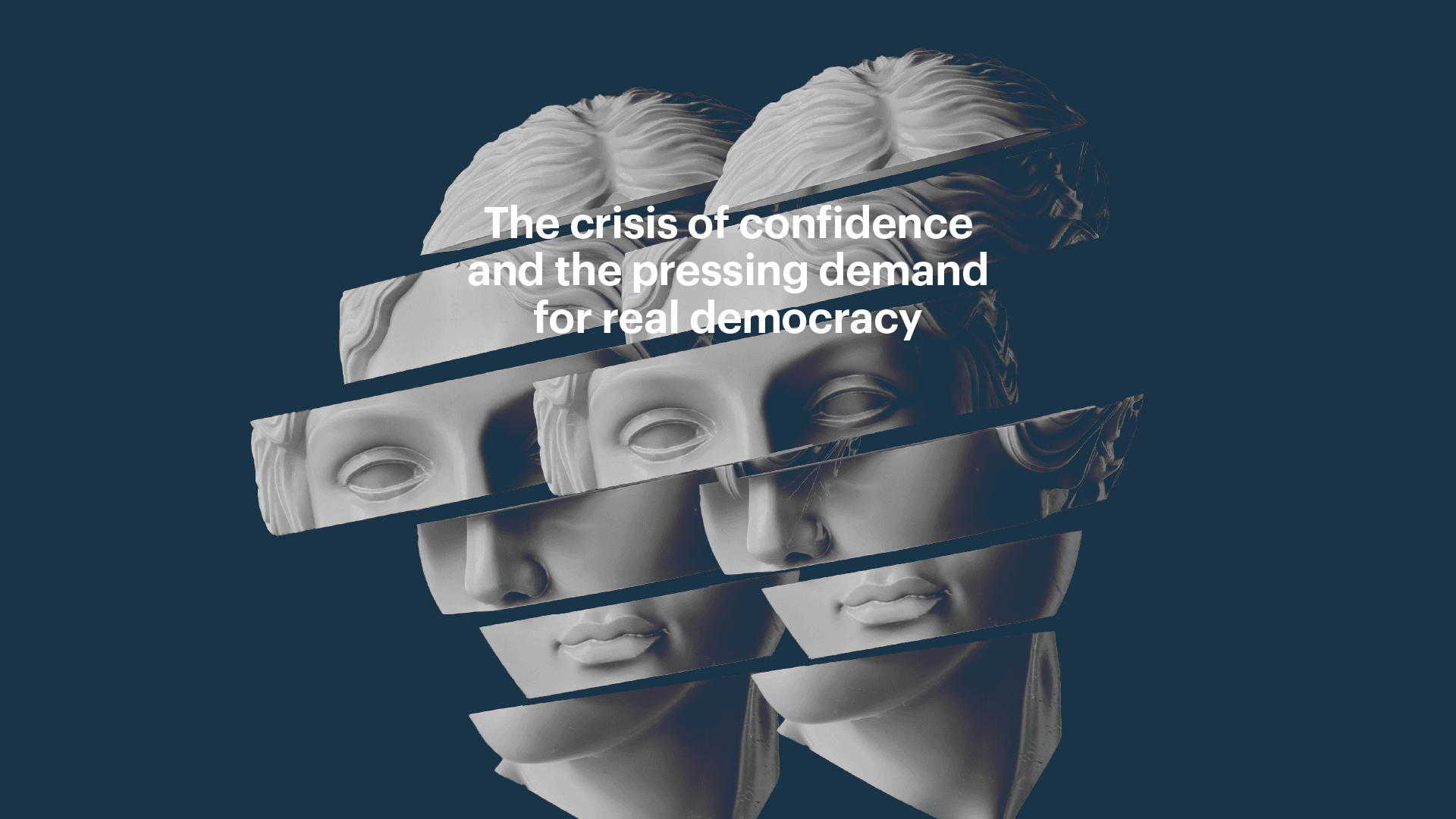
The crisis of confidence and the pressing demand for real democracy

Vouliwatch
In a recent research on democracy in Greece conducted jointly by Eteron and Vouliwatch, something that we all more or less knew was recorded with striking clarity. Trust in the political system of party representation and in politicians has shrunk dramatically. In fact it is almost non-existent. The majority of citizens believe that political parties don’t have capable and honest cadres, that they aren’t interested in the welfare of society nor that they’re striving for the collective good. What prevails is frustration and a general feeling of disillusionment stemming from the belief that politicians today are dependent on financial and party interests and are only interested in maintaining their position of power, without any real connection to the problems of everyday life.
This crisis of representation is deepening every year and is affecting citizens’ attitudes towards the concept of participation and political expression. It is no coincidence that there is an ever-increasing rate of abstention from voting and a resort to a kind of “indignant apathy”. In fact, this overall disillusionment goes hand in hand with the worrying rise in popularity of various political figures who have Trump-ish characteristics and offer easy solutions to complex problems, exploiting the fears and concerns of a society that feels frustrated and vulnerable. In this way, society is becoming increasingly polarised, with citizens nesting in their private spheres, consuming the information served to them by algorithms on their mobile phones.
This trend is not a theoretical observation, but arises from and is fuelled by the citizens’ experiences: There is a striking lack of punishment for major corruption scandals, irrelevant amendments are added at the last minute to critical bills, bypassing the timely information of the public or the parliamentary body, while serious national issues that undermine the rule of law (such as the wiretapping scandal and the Tempi train disaster) have led to misinformation and communication tricks, fragmenting accountability. Such conditions shape an impression of politicians that operate within party lines, while being protected and distanced from the social pulse and the demands of citizens.
A dystopian optimism: when interpreting the results of the research and sifting through the participants’ explicit answers, despite the discouraging and uncertain descriptions, despite the widespread mistrust and alienation from the traditional exercise of politics by the parties, a vital belief in the very idea of democracy emerges, as a political system, a framework for the organisation of collective life and an ideological one-way street for the future. In other words, citizens continue to believe in the separation of powers, independent authorities and the importance of transparency and accountability. At the same time, however, they demand that democracy becomes more open and participatory. The demand, therefore, is not to tear down institutions or to completely dismantle and destroy the democratic system, but to make them function effectively, protecting them from arbitrariness and abuse of power.
Our research also reveals that society is fully aware of the threats to democracy. Corruption, lack of justice and manipulation of the media are consistently identified as the most dangerous phenomena undermining the political system. In other words, the main cause for the current crisis of democracy is not “citizen apathy”, as is often claimed in public discourse. Citizens clearly understand that the institutions – which are supposed to ensure equality and transparency – are not adequately fulfilling their role and are being systematically eroded. When critical corruption cases drag on for years or important investigative journalism revelations somehow “vanish”, it is natural for trust in institutions to be shaken, almost irrevocably.
Another reassuring finding is that the majority of citizens do not look to a “savior” to clean up the political system, nor do they pin their hopes on the promise of a strong leader. On the contrary, the majority of citizens believe that strengthening democracy requires their own participation as well as effective oversight institutions that work consistently and with integrity. Hence, proposals such as the abolition of parliamentary immunity or the strengthening of independent authorities resonate with them. This suggests that Greek society seems to have matured after (the restoration of democracy in) 1974 in terms of its understanding of democracy and treats it as a deeply collective endeavour.
The research findings also reveal the impressive and somewhat unexpected positive attitude of a section of the population towards alternative forms of participation. From citizen campaigns and legislative initiatives to participatory budgeting and local referendums, a significant segment of society states that it would rather do more than merely vote every four years. In fact, they seem to want a constant and active presence, with a decisive say in the decisions and policies that affect their daily lives. In this day and age, technology offers the possibility of transparent and impartial processes that could bring citizens closer to decision-making at local and national level. The demand for institutionalised participatory processes is not just an idea of some progressive elites, but a practical requirement of our times, a demand that is achievable.
Even more interesting is the element of intergenerational convergence. Our research did not reveal any significant differences in opinion between younger and older people, nor between social groups with different levels of education. This means that the demand for greater transparency, accountability and participation is a common hope that runs through society as a whole. The younger generation, often accused of keeping its distance, appears willing to participate by activating new tools of democratic participation. But even the older generation, worn down by decades of pathologies, seems to share this contemporary shift. This convergence transcends the traditional, hard-line left-right divide that still exists in Greece, as well as the social division that for years has kept political life in a state of deadlock. It is perhaps the first time in decades that Greek citizens seem ready, in the post-dictatorship era, to seek and pursue a common vision, to work together in order to save and strengthen democracy and the rule of law. And this is a challenge that concerns everyone, because defending democracy is not a matter for one political camp but is in the common interest of society as a whole.
Another message that runs through our research is the need to renew political discourse and the relationship between politicians and voters. Citizens are not just looking for new faces, but also for an alternative way of communicating. They are clearly tired of the bad-old-wooden rhetoric, communication clichés and empty confrontations. They crave a political discourse that is honest, direct, contemporary and dignified, that speaks to their real experiences, includes their realities and does not treat them as passive recipients. Behind this demand for a “new discourse”’ lies something more substantial and profound, namely the long-overdue or mature need for a change in political culture. Shifting cadres around or even the mere addition of new faces on the political scene is not enough, if the way power is exercised remains unchanged, if decisions are taken in secret behind closed doors and without proper accountability, if confrontations are limited to communication tricks and if, in principle, ideologically opposed political forces operate, in part, under a code of silence. What emerges, therefore, as a demand from citizens is a renewed and different framework for the relationship between society and politics – one that does not reproduce the pathologies of the past but dares to defeat and overcome them. A political culture in which mistakes can be acknowledged, responsibilities can be shared, and where ideas can arise from the grassroots and practices of transparency are adopted, as has been the case in other European countries that have chosen the path of open governance. Without this profound change in mindset, even the most well-designed institutional reforms risk remaining a dead letter and ultimately reinforcing cynicism rather than trust.
At this point, Vouliwatch emerges as a critical bridge to progress. In our ten years of operation, we have proven that political trust is not a given but rather that it’s built through transparency, access to information, accountability and real opportunities for participation. According to this very research, this is precisely what citizens consciously and emphatically demand. Driven by this demand and with the substantial encouragement of the citizens who follow us and support our work, we continue to intervene by creating digital participation tools and specific proposals, from regulating lobbying and enhancing transparency in party finances and sources of funding, to broad institutional protection for whistleblowers and the activation of citizens’ legislative initiatives.
Two key conclusions emerge: on the one hand, there is a deep lack of trust in the country’s political system; on the other, there is a moving hope of a society that has not given up the fight for meaningful democracy. How the Greek political scene will evolve depends on whether the powers that be will actually listen to social demands and respond promptly and courageously to the needs of modern democracy, or whether they will blindly continue to reproduce the same pathologies with unwavering utilitarianism and arrogance. In any case, we shall continue our struggle unabated and will press with all our might to create and establish the conditions for a vibrant, participatory, inclusive and true democracy!