- About the project
The project “Unmute Democracy” is carried out in collaboration with VouliWatch and looks into the citizens’ stances towards the functioning of democracy in Greece today, recording both their perceptions of the main threats as well as their evaluations of potential institutional checks and balances, and also forms of political participation that could improve the quality of the democratic political system and strengthen citizens’ engagement in public affairs.
The research is based on a public opinion questionnaire that examines: (a) the evaluation of the way that democracy functions, (b) the threats that democracy is currently facing, (c) the pathologies of political parties, (d) attitudes towards electoral systems and forms of governance, (e) citizens’ willingness to participate politically at different levels, and (f) support for or opposition to institutional interventions concerning transparency, accountability, and the oversight of power.
- Research material
- Identity
The research project was launched in September 2025 and focuses on the study of the quality of democracy in Greece.
Project Coordinator: Dr Antonis Galanopoulos, PhD in Political Science, Aristotle University of Thessaloniki (a.galanopoulos@eteron.org).
- Contributors
Representation, participation and renewal: a social demand for institutional reform

Introduction
In the spring of 2025, Eteron – Institute for Research and Social Change conducted a large-scale research entitled “X-ray of Greek Voters” in order to map the ideological stances and political views of the Greek electoral body. On one hand, this was a way for us to see political parties through the eyes of their voters, i.e. a bottom-up approach to political parties, but in the process, we realised that the findings provided a revealing picture of citizens’ views and stances towards democracy, several institutions and what we commonly refer to as the “political system”.
I should point out, right from the start, that although the vast majority of voters agree that, despite its weaknesses, there is no better form of government than parliamentary democracy, 74.3% of citizens stated they were dissatisfied/somewhat dissatisfied with the way democracy currently functions in Greece. Subsequently, low confidence was recorded towards the eight institutions under review, with said trust levels being even lower than in the corresponding survey of 2023. Political parties ranked second to last in the citizen confidence index, with a confidence rating of just 13.6%.
The latest “Unmute Democracy” research (based on a sample of 1,876 citizens) is conducted in collaboration with Vouliwatch and focuses on aspects of what we have referred to above as “the way that democracy functions”, i.e. citizens’ perceptions of the meaning and quality of democracy on the one hand and the political system in general on the other. Liberal representative democracy has inherent tensions, which have been described as the “democratic paradox” (Mouffe, 2008). What we nowadays call “liberal democracy” is the result of the convergence of two traditions, the democratic and the liberal. The articulation of these two traditions, however, was contingent and not inevitable.
Recent studies argue that contemporary democracy is undergoing changes that could lead it towards elitism, with limited participation by the people, or towards reactionary forms (Mondon & Winter, 2020), with exclusion prevailing over inclusion. The quality of democracy, both in Greece as well as across the globe, is also affected by the imbalances of power and political influence caused by ever-widening economic inequalities, the restriction of pluralism in the mainstream media, corruption, and the intertwining of political and economic power, which leads to the oligarchisation of politics internationally. In the current context, the shadow of the Tempi train disaster has raised questions about the functioning of institutions and the rule of law and has led to a collapse in public confidence towards political parties, the government and the justice system. The focus is inevitably on the functioning of the parties themselves, since they are the pillars of the political system.
Taking into account this crisis of public confidence in the institutional structure, public disappointment with the way that democracy functions, and the broader debate on the ongoing transformations of democracy, this project seeks to identify the key democratic challenges of our time, the threats to the future of democracy, and possible prospects for renewing the political system to ensure a more democratic version that would better satisfy citizens. To this end, we’ll examine possible interventions that are often discussed in the public sphere as potential ways to make our democracy more functional, more representative and, ultimately, more democratic.
Disappointment and threats to the future of democracy
As established above, feelings of disappointment with the way that democracy functions are detected in large sections of society – almost three-quarters of it, to be precise. But to what extent are we disappointed? The research findings show that the degree of disappointment is correspondingly high. Citizens rate the functioning of democracy below the “pass threshold”, so to speak, with an average score of 3.85/10. Nineteen per cent rate it as 0, thereby expressing complete dissatisfaction. The share of those who express complete dissatisfaction is six times larger than that of the citizens who are completely satisfied – only 3.1% rate the functioning of democracy as 10. One in ten citizens (10.4%) give it a 5 (the above-mentioned “pass threshold”), while 57.4% of citizens place themselves on the south side of that threshold, and 31.6% place themselves on the positive spectrum.
The lowest ratings were found among young people aged 17-34, with just 3.23/10. That number rises slightly in other age groups, with the maximum rating (4.18) being detected among those aged 55+. This finding is entirely consistent with what we found in the analysis of young people that we did as part of the “X-ray of Greek Voters”: “the highest rates of dissatisfaction are observed amongst the two youngest age categories, with the relevant percentages being almost identical: 87.2% amongst those aged 17–24 and 87.1% amongst the 25–34 age group”. The assessment is slightly more favourable amongst residents of Attica (4.01) than amongst those living in the rest of the country (3.70) and slightly more positive among those who have received higher education (4.02). In any case, there are no striking deviations from the average of the general population in terms of satisfaction with the functioning of democracy. On the contrary, there is a consistently low rating (slightly above or slightly below 4) among all categories examined, indicating widespread dissatisfaction across social categories.
The next objective of the research was to examine what citizens perceive as a threat to the functioning of democracy, in an attempt to explain the low level of satisfaction recorded. Among the options, which represented different political stances, there was a pair of closely linked threats that stood out. This allows us to argue that there is a clear explanation behind citizens’ dissatisfaction with the way that democracy functions today. The pair of threatening factors in question are the corruption of the political system (59.4%) on one hand, and the lack of justice and impunity (57.6%) on the other. These two responses account for more than 50% (53.1%-65.5%) in all the different sub-groups of the research sample (age, place of residence, education). Corruption in the political system and impunity have a decisive influence on how citizens perceive the quality of democracy in Greece. Accordingly, there is a clear demand for accountability and justice, which is also evident in other questions, as we shall see below, and is in line with the widespread social demand for justice that has been recorded in numerous demonstrations and actions surrounding the Tempi deadly train accident over the past few months. Corruption is perceived as a greater threat by young people (65.5% of those aged 17-34), and it is worth considering what this means when we look into the matter of young people’s participation in politics. How and to what extent should they participate in something they consider to be deeply corrupt?
The third most significant threat is the political and economic control of the media (32.3%), proving once again that the low quality of information affects the quality of democracy itself. Of the 13 options in total, there’s only one more that exceeds 20%, and that is economic inequalities that reinforce the power of elites. Colin Crouch, who introduced the concept of post-democracy, has emphasised that the great inequalities that govern relations between business interests and almost every other social group are the main cause of the decline of democracy. The unequal power of wealth translates into unequal political power and influence over political authority. This is closely linked both to the existing inequalities and to the economic control of the media. Both are connected to the unequal influence that specific interests have in the political domain, which is thereby increasingly becoming a closed affair that only concerns a closed circle. Inequalities undermine social cohesion, “without which representative democracy is destabilised” (Dimitriou, 2025, p. 26). It is noteworthy that, once again, young people aged 17-34 attach greater importance to the issue of inequality (30.2%) than both the general population (24.4%) and older age groups (25.4% among those aged 35-54 and 20.8% among those over 55). On the other hand, issues that are often discussed in the media, such as artificial intelligence, digital manipulation, foreign interference in domestic politics or electoral processes, are not seen as significant threats, and record single digits.
In this case, the level of education seems to differentiate the individual results quite significantly. In five of the possible answers, there is a difference of more than five points (>5%). In four of these, the difference is in favour of citizens with higher education. They consider the rise of far-right ideologies and authoritarian tendencies, populism, political and economic control of the media, and the undermining or ineffectiveness of independent control institutions to be the most significant threats for democracy. The difference in these four cases can be interpreted as an indication of the close link that these citizens have built with knowledge, information and rationality, or it could also be seen as a sign of greater identification with liberal principles. The only case where the difference leans towards those with secondary education is the threat posed by the challenges to social cohesion from so-called migration flows.
Threat assessment
By level of education
Secondary education | Higher education | ||
Rise of far-right ideologies | 10.7 | 15.8 | +/- 5.1 |
Populism | 11.1 | 16.5 | +/- 5.4 |
Media control | 27.7 | 35.1 | +/- 7.4 |
Migration flows & social cohesion | 18.1 | 10.5 | +/- 7.6 |
Undermining of independent monitoring institutions | 8.7 | 16.4 | +/- 7.7 |
The objectives of the interventions that citizens believe could improve the way that democracy functions are in line with the threats they detected in the previous section of the survey. The first thing citizens want is to limit the influence of large economic interests (55.7%). This is followed by ensuring the separation of powers (40.6%) and, in third place, strengthening forms of direct democracy (33.5%), a position that is closely linked to the representation of citizens’ views. The most significant differentiation between the sample’s demographic categories is observed in the demand for the guaranteed separation of powers. That particular claim seems to be more closely linked to residents of urban centres (43.6% of Attica residents think that should be a priority compared to 37.8% of the residents of the rest of Greece) and even more so to people with higher education level (47.2% vs. 28.8%). If this is a response that is closer to liberal democracy, it is interesting to point out that the only response that was more often selected by residents of the periphery (37.2% vs. 29.6%) and secondary education graduates (37.4% vs. 31.5%) is the strengthening of forms of direct democracy. This reveals a very interesting distinction that warrants further study.
We then examined what citizens consider to be the biggest issue with political parties. The two most prevalent answers are, in a way, a reflection of the participants’ responses regarding the threats that democracy faces. The first problem identified by citizens is the lack of competent and honest officials (40.2%) in the existing parties – an answer that is partly linked to the issue of corruption – and the second issue detected was the parties’ dependence on financial interests (30.6%) – a response linked to media control and the inequalities mentioned above. It seems that parties and democracy face problems of the same order, a fact that is not surprising at all, given that parties, due to their institutional role, are the pillar of the democratic political system. Their dependence on financial interests, as perceived by citizens, is an expression of the threat that inequalities pose to our democracy. The perception of widespread corruption threatening the proper functioning of democracy translates into a demand for honest politicians and cadres.
There were two cases in which we observed a difference of more than 5 points: a) the lack of competent and honest officials seems to be a more important problem for women (42.9% compared to 37.3% for men, +5.6%) and b) dependence on financial interests is more significant for graduates of higher education (32.6% compared to 27.2%, +5.4%).
The challenge of representation
Beyond the crisis of confidence in the political system and dissatisfaction with the way that democracy functions, both public debate and the findings of the recent “X-ray of Greek Voters” focus on the crisis of representation, as a large part of the electorate feels that it is not represented by the parties or even by the political system in general. The most characteristic symptoms of this crisis today are the steadily increasing abstention from electoral processes in recent years and the fragmentation of the party landscape, with the emergence of new parties both as a symptom of the lack of representation and as a possible – albeit probably distorted – attempt to represent increasingly niche and limited particularities.
Identification with a party is the result of a bond of representation and trust. To build this bond, parties must, in every situation, find the political vocabulary and communication practices necessary to express the concerns, experiences and demands of citizens, but also to engage in dialogue with the social groups they wish to represent. This requires will and skills.
The findings of our research show that, in addition to the breakdown of trust, another channel that seems to have broken down is that of communication between society and political parties. 53.6% of respondents believe that political parties and politicians are unaware of citizens’ views on important political issues. When the question is slightly modified to whether respondents believe that parties are interested in finding out what the views of citizens are, the answer is overwhelmingly negative. 80.5% somewhat or strongly disagree with the statement that parties are interested in finding out what citizens think about important political issues. In fact, one in two (49.9%) strongly disagree, while at the other end of the spectrum, only 3.9% strongly agree.
Let us focus on some more detailed data concerning the second question, that of the interest or intention of political parties to find out the views of citizens. In the general sample, only 18.3% believe that such interest exists. Although the difference observed is not that significant, men (21%), residents of Attica, the country’s boggest urban centre (20.7%), and graduates of higher education (20.6%) tend to identify this interest slightly more than the rest of the demographic groups. Moreover, it is interesting to highlight the way that young people view this matter: amongst this particular age group, the percentage drops significantly to 11.7%, creating a difference of about 10 percentage points compared to respondents aged 55+. Young people, therefore, feel, even more so than the rest of us, that parties and politicians are not interested in finding out what they think about political issues and what concerns them.
This blocked communication indicates that the party system needs renewal as well as feedback: an influx of information into a closed system. The most common solution we encounter in public discourse is that of “experts”. Indeed, 61.7% of citizens believe that the quality of democracy will improve if parties and politicians listen to the opinions of experts more. It is not surprising, however, that even more participants believe that democracy would improve if parties listened to the views of citizens. This position is almost universally accepted (90.1%), with a single-digit percentage of disagreement (7.2%). Interestingly, there are no significant differentiations between the different demographic groups in the sample on these two positions, although one might have expected to find a significant difference based on the participants’ level of education. There is a difference, but it is quite limited (+3.1% in favour of experts and technocrats among higher education graduates and +4.9% in favour of the citizens’ view among secondary education graduates).
Peter Mair highlighted the crisis of representation in Western democracies and the inability of political parties to represent society. He called the challenge he described as the failure of parties to perform their representative function and the widening of the so-called democratic deficit “governing the void” (Mair, 2020). Here, we shall focus on another analysis by Mair (2009) in which he discusses the relationship between representative and responsible governance. When explaining the widening gap between representation/responsiveness and accountability and the declining ability of parties to bridge or address this gap, he argues that governments are finding it increasingly difficult to respond to voters’ demands because it is becoming more and more difficult for them to understand the voters’ preferences. This difficulty or unwillingness was clearly reflected in the two questions we examined above. Mair’s explanation is that parties have withdrawn from civil society and now have a smaller and less representative membership base (Mair, 2009, p. 13). However, the problem does not end there, as, according to Mair (2009, p. 14), the principles and restrictions that oblige governments to behave in a certain way in the name of responsibility are increasing. Thus, although it is generally considered desirable for parties in government to be both representative and responsible, these two characteristics of governance are becoming increasingly incompatible (Mair, 2009, p. 15). This, combined with the fact that these principles and constraints are beyond political – and popular – control, creates new tensions between voters and parties.
This gap between what citizens would like governments to do and what governments (are forced to) do explains, according to Mair (2009, p. 17), the disappointment and dissatisfaction that characterises democracy today. Our assumption, therefore, was that this gap also exists in Greece and that several “governmental” parties often sacrifice the function of representation while claiming that they need to do so in order to act responsibly. We therefore indirectly posed this dilemma to the research participants, attempting to describe two stances that express the principles of representation/responsiveness on the one hand and responsibility on the other. The participants recognised the patterns described, and the majority (55.5%) sided with representation/responsiveness, choosing as preferable the statement that governments should implement the programme and policy choices that the people voted for in the elections, thus fully respecting the popular mandate. On the other hand, 39.3% sided with responsibility, believing that governments should make decisions that they think are in the best interest of the country, even if it goes against the programme that got them elected.
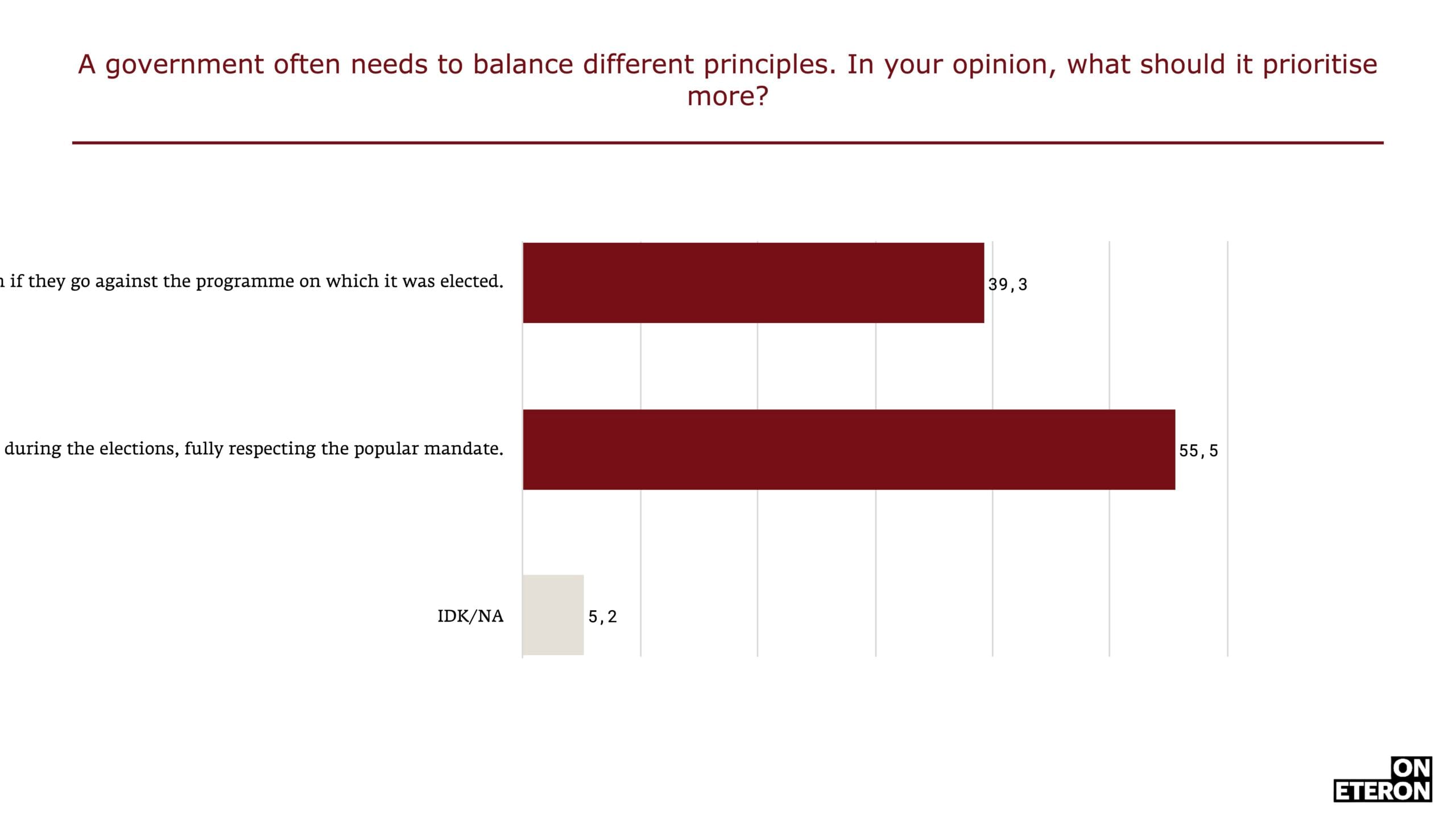
No significant differences were observed between the various age groups, but we did find interesting discrepancies in the other demographic categories. Although this stance was not in the majority in any demographic group, those that proved to be more in favour of prioritising responsibility were men (43.3% vs. 35.5%), Attica residents (41.3% vs. 37.4%) and graduates of higher education (41.7% vs. 35%). Even though, as mentioned earlier, no significant differences were observed between age groups, it is worth noting that, based on data from other questions, young people aged 17-34 seem to have a greater interest in the issue of representation overall. For example, the inability of parties to represent society (29.6%) was considered by this group to be just as big a problem as their dependence on financial interests (30.6%), and in fact they express that opinion more than any other age group (+5.1% above the sample average). Furthermore, in response to the general question about the goal of the interventions required, a higher percentage of young men and women (18.5% compared to 10.9%, which was the sample average) chose the option of greater representativeness of the political system.
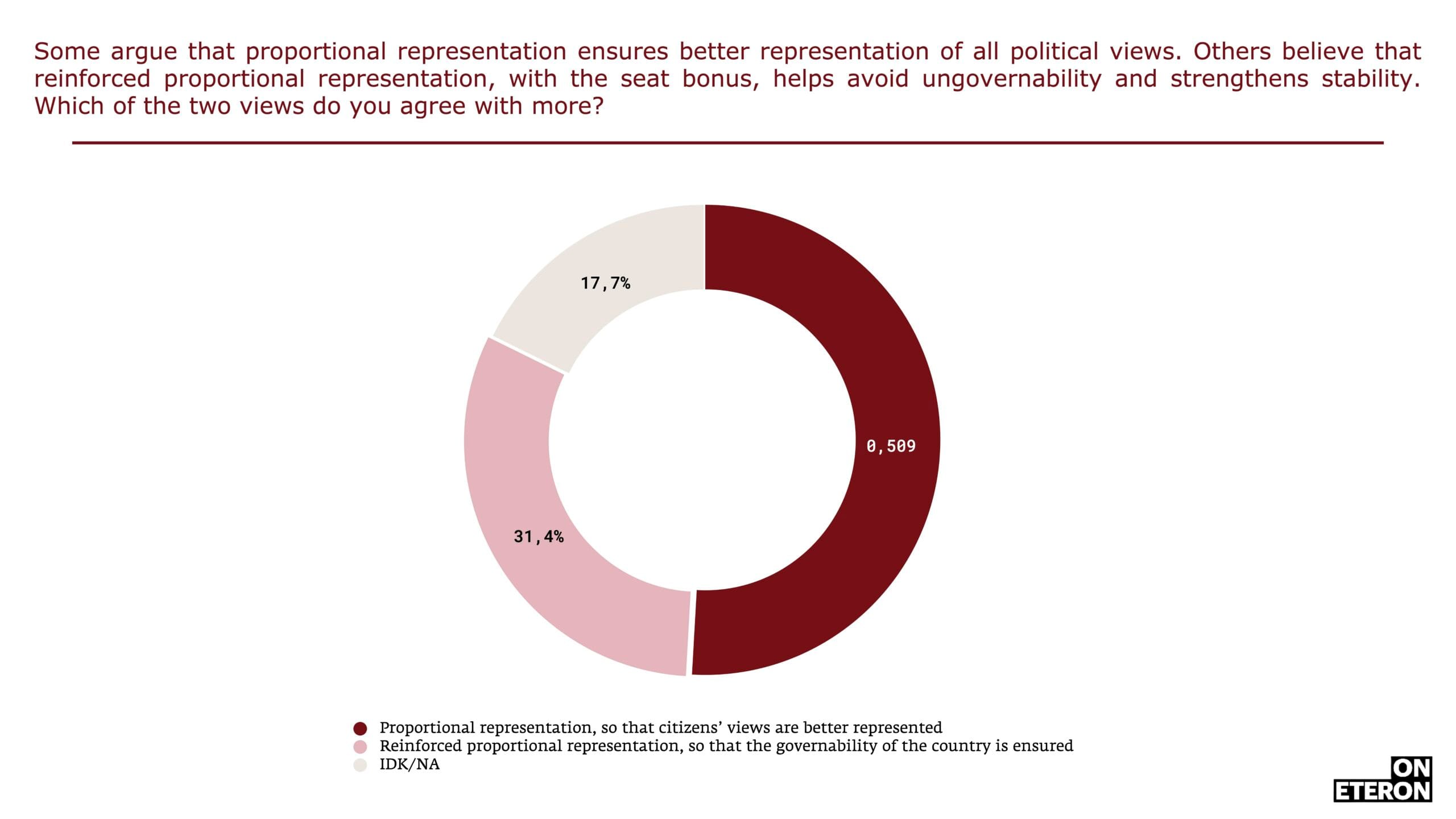
With a number of findings on our hands indicating that citizens are concerned about their representativeness and favour the principles of representation, we sought to examine whether this stance influences their perception of the electoral system, with the choice being between simple proportional representation for better representation and reinforced proportional representation to ensure governability. This question had the highest percentage of “I don’t know/ Prefer not to say” responses (17.7%), which shows how tricky that particular dilemma is. In any case, the majority (50.9%) choose simple proportional representation, insisting on the value of representativeness. The lowest support for simple proportional representation was recorded among citizens over 55 years of age (47.8%) and the highest among young people aged 17-34 (57.5%).
Such findings prove that the issue of simple proportional representation cannot be considered as settled within the context of the Greek political system. It remains something that needs to be discussed in a structured manner, without underlying agendas of possible electoral exploitation, with the participation of political parties and civil society organisations.
The whole set of questions we have included in this section once again documents an open crisis of representation and a demand for citizens to have a voice that will be heard as well as adequate representation in the political system and in parliament. Addressing this issue is a prerequisite for the active participation of citizens in political life, both technically and substantively, and ultimately the foundation for a healthy and vibrant political system.
How can the political system be changed?
It is commonly accepted that the Greek political system needs to change in order to regain the trust of citizens. In our research, we sought to explore the direction in which citizens would like these changes to be.
Having identified a trend towards incorporating forms of direct citizen participation, in the spirit of direct democracy, we shall begin by presenting some ideas of this nature that were examined in our research. As expected, there is broad support for the perspective of holding referendums (80.6%). This support does not fall below 77% in any of the demographic categories examined, with the highest percentage observed among young people aged 17-34 (87%). Furthermore, the pattern we have already noticed several times by now is repeated once more, namely that residents of Attica, as an urban centre, and graduates of higher education take a more “liberal” stance. Therefore, in this particular case, they express a more moderate support for the holding of referendums. Moreover, it is worth mentioning that citizens are positive about the holding of referendums both on a national and a local level (62.1%). Rejection of any kind of referendum falls to 9.5% compared to the 16.3% share who were against holding referendums on important issues affecting the country. It is possible that part of the difference shifted towards the option of holding only local rather than national referendums, a position supported by 11.1% of the sample.
In the recent revision of the Greek Constitution that took place in 2019, the institution of popular legislative initiative (PLI) was introduced for the first time. According to paragraph 6 of Article 73, “Upon signature by five hundred thousand citizens having the right to vote, up to two law proposals per parliamentary term may be tabled in Parliament”. The popular legislative initiative can be seen as an institution of direct democracy that strengthens the democratic character of the Constitution. Citizens agree and the majority (50.5%) believes that this institution will reinforce the quality of democracy. However, a significant percentage (24.4%) believe that this provision is practically unenforceable. Only a small percentage (17.7%) oppose such initiatives, stating that there are more risks in it than positive elements. At present, those who are unsure whether such a PLI will be enforceable are ratified, as six years after the constitutional revision, the executive law necessary to activate this provision has not yet been passed, and therefore the popular legislative initiative remains a dead letter. It exists in name only and is another indication of the unwillingness of the government and the parliamentary majority to include the people’s will in the decision-making process and legislative work. One might call this phenomenon a case of democracy-phobia.
Although citizens seem to be positive about this PLI, few feel they would take the initiative to draft such a proposal (9.8%). The group that shows the greatest willingness to do so is young people (14.5%). Obviously, such a process is not simple, nor can it be carried out on an individual basis. It could be realised as a result of collective initiative, since it requires teamwork and, of course, presupposes a dynamic support campaign in order to collect the necessary signatures. This is reflected in the fact that 79.4% of the research participants state they would support such a campaign with their signature. This attitude is widespread and permeates all demographic categories of the sample without any particular deviations. An indication that this sentiment is genuine can be found in the 1.3 million signatures collected in the resolution drafted by the association of families of victims of the Tempi train accident for the revision of Article 86 of the Constitution and the abolition of parliamentary immunity. As Professor Kontiadis notes (2025, p. 265) this campaign is neither a popular legislative initiative nor is it institutionally provided for in the context of the constitutional revision process, but I reckon that it can be interpreted as an indication of the willingness of the people to participate in such initiatives.
In his recent book, Stefanos Dimitriou (2025, pp. 11, 14) argues that the current crisis of democracy urgently calls for its institutional renewal and stresses the fact that a reform of the political system should be a strategic goal for the country’s development and prospects. Below, we shall examine certain reforms or prospects for the renewal of the political system, which we have divided into three categories: a) institutional interventions in the electoral and political system, b) proposals aimed at improving citizen participation, and c) measures for transparency and control of power.
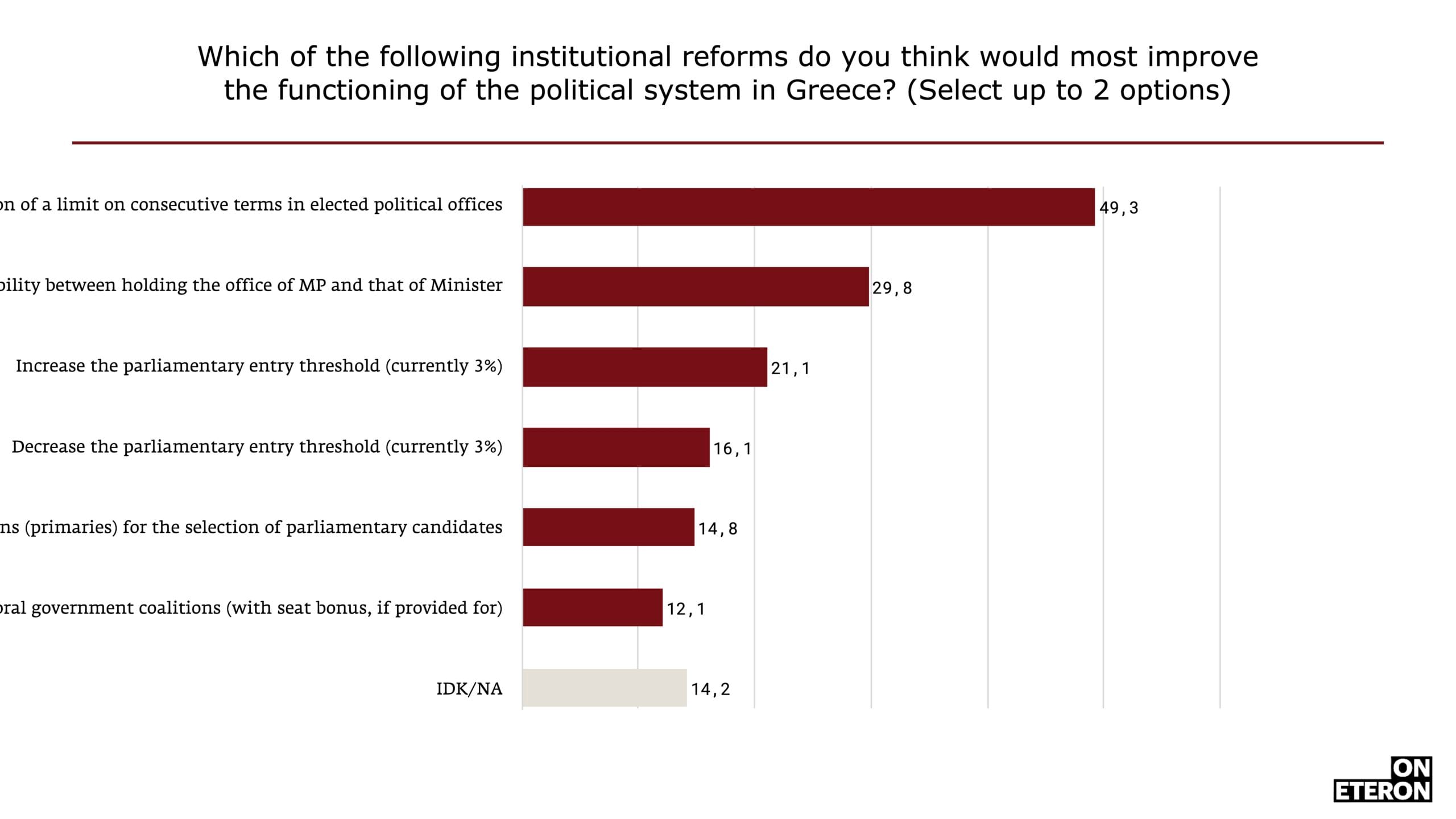
Among the institutional interventions, the one that stands out is the introduction of a limit on consecutive terms in elected political office. Citizens could select two of the six alternative options presented to them, and almost half (49.3%) picked the term limit. This measure could be seen as a kind of restriction on popular sovereignty, in the sense that it prevents the re-election of a politician whom voters might decide to re-elect. On the other hand, we shouldn’t ignore the fact that consecutive terms give politicians significant advantages that create unequal conditions of well-intentioned competition, often making the renewal of political personnel practically impossible. The demand for a limit on consecutive terms is de facto a demand for a political landscape renewal. And citizens seem to be looking for a way to bring about this renewal, even if it means resorting to “enforcing” it. The percentages for the other interventions are relatively low. There is no clear trend in favour of reducing or increasing the threshold for entry into Parliament, which currently stands at 3%. The only other measure that stands out slightly is the incompatibility of mandates between MPs and ministers (29.8%). Let us take a closer look at the differences observed within the sample’s demographic sub-groups. Firstly, one in five women (19.7%) chose not to answer, which is more than double the respective percentage amongst men. A similar percentage (19.8%) was recorded among young people, while the lowest percentage of “IDK/NA” was found among citizens that are over 55 years of age. Young men and women seem to prefer lowering the threshold for entry into Parliament, while the rest of the age groups would rather see it raised. This is clearly linked to the greater interest of young people in a more representative system, as we saw earlier. They are also more positive when it comes to the idea of introducing internal party elections to select party candidates [primaries] and more cautious about the term limit, although the latter remains the most popular intervention in this age group. The biggest difference based on the participants’ education level concerns the last measure/ intervention in terms of order of preference, i.e. the possibility of pre-election government coalitions. Higher education graduates favour this measure more than others (14.1% vs 8.5%). Such a provision would allow voting based on representation but would address the criticism or threat of ungovernability by committing parties in advance to specific potential government blocs.
Next, the survey participants were asked to rate four measures in terms of their usefulness in increasing citizen participation. People responded positively to measures that involve them in the decision-making processes, i.e. the use of applications for participation in consultation and decision-making (73.8%) and the idea of participatory budgeting in local government (70.8%). In reality, existing consultation tools, such as OpenGov, do not have mass participation. This could at least partly be due to the fact that their role is strictly advisory and they do not substantially influence the actual decisions that are taken. It is an open question whether citizens would participate more, or indeed to the extent that they indicate they would like to, if these tools allowed them to intervene more significantly – perhaps in local issues – or if said tools were more modern and user-friendly. Participatory budgeting is indeed a democratic institution, but it is still rarely implemented by Greek municipalities. The acceptance rate of e-voting is particularly high (69.6%), and it is in fact the option with the highest rate of explicit agreement (47.4% “agree” and 22.2% “somewhat agree”). On the other hand, the more radical option of drawing lots to elect some members of parliament is rejected by citizens (52.8% disagree/somewhat disagree vs. 36.3% who agree/somewhat agree). This shows, in a way, that citizens are ready to consider reforms and changes, but they prefer those interventions to be in line with the existing structure.
In this set of questions, we can identify a small number of interesting differentiations between the various demographic groups. The two most significant ones relate to the level of education. Participatory budgeting and lottery-based political cadres selection are more popular among secondary school graduates and less so among university graduates. It is striking that those with higher levels of formal education remain systematically more cautious regarding broader popular participation, with a particularly notable difference on the issue of drawing lots to appoint officials. American historian Thomas Frank (2021, p. 308) includes high education among the factors that lead to an aristocratic-type contempt that fuels the belief that a certain group of people are entitled to rule because they are “better” than the ordinary or “common” people. The democratic ideal, however, is based on the opposite claim, as democracy is at its core “the self-government of equals” (Keane, 2009, p. 865).
Secondary education | Higher education | Margin | |
Participatory budgeting | 76.4% | 68.3% | +/-8.1% |
Officials being appointed through lot | 46% | 31.3% | +/-14.7% |
It is also interesting to note that women have a more positive stance towards the lottery measure than men (41.5% vs. 31%). One might reasonably wonder whether the low representation of women in Parliament, which is limited to just 23.3%, is a factor that explains this difference.
The last set of questions examines measures in order to achieve transparency and control of power. Here, too, participants were given the opportunity to evaluate five possible measures and interventions. If we recall that issues of inequality and justice were rated as priorities by citizens, then their choices in this part of the research are not just reasonable but also consistent. The two measures that enjoy almost universal acceptance are changing the way senior judges are selected so that they are not appointed by the government (93.7%) and abolishing parliamentary immunity (93.1%).
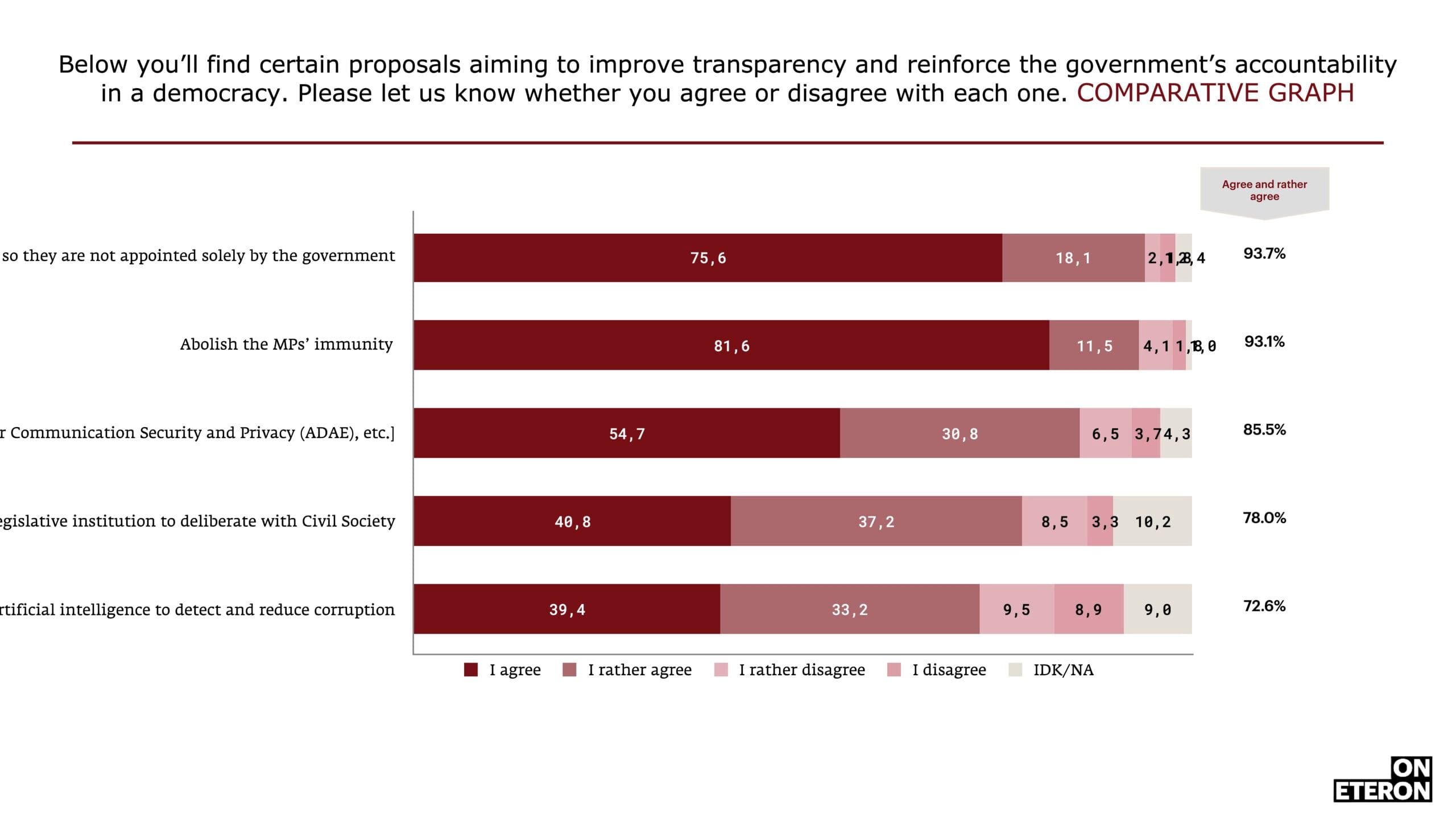
The response to all five suggested measures and interventions was positive both in evaluation and numbers, with the lowest acceptance rate recorded being as high as 72.6%. The third most popular option is the strengthening of independent authorities (85.5%). Be reminded that independent authorities are the institution with the third highest confidence rating (32.1%), according to the “X-ray of Greek voters 2025” research, and actually the top ranking one in terms of trust among the younger age groups of 17-24 and 25-34 yo. It is interesting to note that even the suggestion to use artificial intelligence to combat corruption is embraced by citizens (72.6%). The people’s opposition to corruption in the political system may prompt them to be positive towards interventions that promise to tackle such phenomena, even if their outcome is extremely uncertain. In mid-September, neighbouring Albania appointed its first Minister of Artificial Intelligence, Diella, responsible for public tenders and public contracts. Since this is one of the sections with the highest degree of corruption, the automation and impersonal nature offered by artificial intelligence and algorithms was seen as a possible solution to the problem. As researcher Vera Tika (2025) notes, we have a situation where political power is transferred to digital forms [avatars] that are presented as neutral, incorruptible and “clean”, but which aren’t subject to democratic accountability. Algorithms and artificial intelligence are not tabula rasa; they are based on data provided by humans and on past human knowledge and experience. For example, research has shown that racist bias appeared in healthcare systems using algorithms in the United States, mainly because they reproduced human racism and the inequalities they detected and interpreted from the data with which they were fed (Obermeyer et al., 2019). In general, the use of artificial intelligence can bring us against novel forms of corruption (Köbis, 2023). Interestingly, the younger generation, which is more familiar with such tools – and perhaps precisely for this reason – shows the lowest level of support for this idea (64.9% vs. 72.6% among the general population and 76.5% among citizens aged 55+).
Conclusions
In contrast to the feeling of restriction of their voice that citizens seem to experience within the current political system, the “Unmute Democracy” findings speak out loud and clear. It is no accident that in this particular research project clear majorities are recorded in most of the questions that were asked and a consistent line of thought is observed, from the identification of problems and threats to the citizens’ attitude towards possible reforms of the system.
Citizens are deeply dissatisfied with the way that democracy functions in Greece, and rate it with just 3.85/10. At the same time, they are disappointed by the political system. An important reason for this disappointment, which translates into a lack of trust, is the fact that communication between political parties and society seems to have vanished. Citizens appear deeply convinced that parties and politicians are not interested in hearing their views on critical political issues (80.5%).
The research participants acknowledge two major threats: corruption within the political system and lack of justice. In their opinion, the biggest problem that political parties are currently facing is the lack of competent and honest political cadres, followed by their dependence on financial interests. Therefore, they consider limiting the influence of large financial interests and ensuring the separation of powers to be important factors in improving the functioning of democracy. That second demand, combined with the sense of impunity that citizens feel prevails in the political landscape, leads to almost universal support for measures such as changing the way high ranking officials at supreme courts are elected and abolishing parliamentary immunity.
The research findings reveal three major challenges: a) restoring the principle and connection associated with representation and improving the relevant mechanisms, b) involving citizens in the decision-making process, using participatory methods and tools, and c) renewing the political personnel. On the issue of representation, we saw that the majority of the participants (55.5%) believe that governments should implement the programme and policy choices voted by citizens in the elections, thereby fully respecting the popular mandate, a stance that favours the principle of representation over others. Moreover, the majority (50.9%) state they’re in favour of simple proportional representation when it comes to electoral systems. On the issue of participation, we found that any measure that allows citizens to express themselves – but also to be heard and to take part in the decision-making process, such as referendums, popular legislative initiatives, participatory budgeting in local government, and so on, was positively received and accepted by the participants. Finally, the demand for renewal was expressed indirectly both through the finding that the parties lack capable and honest cadres and by the very high level of support for the measure to introduce a limit on consecutive terms in elected political office.
Any body wishing to consider ways of strengthening the quality of democracy in Greece, restore trust between the political system and society, and reform the institutional framework, must pay close attention to the concerns and demands of citizens. The “Unmute Democracy” project offers some significant primary findings that can help initiate the necessary dialogue.