Tackling the housing crisis in Europe


FEPS
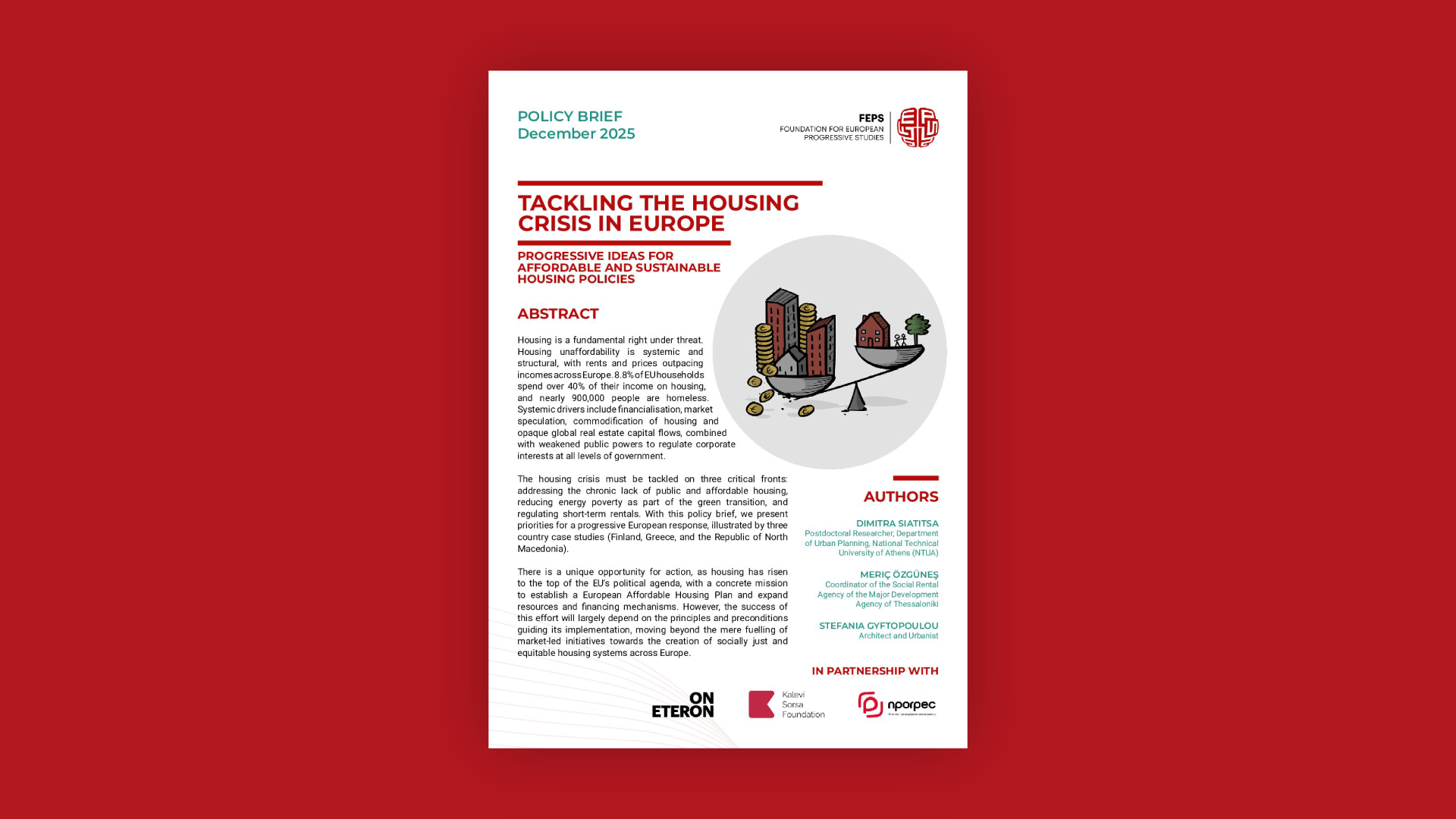
Housing is a fundamental right under threat. Housing unaffordability is systemic and structural, with rents and prices outpacing incomes across Europe. 8.8% of EU households spend over 40% of their income on housing, and nearly 900,000 people are homeless. Systemic drivers include financialisation, market speculation, commodification of housing and opaque global real estate capital flows, combined with weakened public powers to regulate corporate interests at all levels of government.
This policy brief, co-authored by Dimitra Siatitsa, Meric Ozgunes, and Stefania Gyftopoulou, argues that the housing crisis must be tackled on three critical fronts:
Firstly, we need to address the chronic lack of public and affordable housing. Investment in social housing has plummeted, while demand is rising. The EU lacks unified definitions of “social” and “affordable” housing. Expanding public and socially controlled housing is the only structural, long-term solution.
Secondly, we need to reduce energy poverty as part of the “green transition”.Millions cannot afford adequate heating or cooling, undermining health and wellbeing. Renovations risk worsening inequalities if costs are passed on to tenants. Policies must prioritise worst-performing homes and community-led interventions at the neighbourhood scale and protect vulnerable households from “renoviction”.
Thirdly, and finally, we must regulate the fact that short-term rentals and touristification drive rent inflation, reduce long-term supply, displace residents and accelerate housing as a speculative commodity. Cities and non-governmental organisations demand local powers, strict regulation and data transparency from multinational digital platforms.
This policy brief produced by FEPS, in collaboration with Eteron, Kalevi Sorsa Foundation, and the Progres Institute, will be presented at the Tackling the housing crisis in Europe expert meeting at the European Parliament on 9 December 2025. It outlines priorities for a progressive European response, illustrated by three country case studies (Finland, Greece, and the Republic of North Macedonia).
There is a unique opportunity for action, as housing has risen to the top of the EU’s political agenda, with a concrete mission to establish a European Affordable Housing Plan and expand resources and financing mechanisms. However, the success of this effort will largely depend on the principles and preconditions guiding its implementation, moving beyond the mere fuelling of market-led initiatives towards the creation of socially just and equitable housing systems across Europe.
Key recommendations include:
- Expand and protect non-market housing: massively scale up public, cooperative and socially controlled housing; reform EU state aid/services of general economic interest rules to enable this expansion; and built-in safeguards to ensure funding is used for social benefit rather than private profit.
- Guarantee affordability in the green transition: align renovation and energy policies with social protection, prioritising vulnerable households, safeguarding affordability after upgrades and linking climate action to social justice.
- Rebalance power and regulation: shift from a market-first to a rights-based approach to housing; empower local authorities, public, social and cooperative housing providers, and social and solidarity economy actors; curb speculation; and ensure transparency in real estate markets.
- Acknowledge diverse housing realities across Europe: recognise that housing systems differ widely among member states and neighbouring countries. Specific support should be directed to those with underdeveloped social housing sectors or limited institutional capacity.
PB – Housing Handbook DIGITAL
Short on time? Our brochure analyses the housing crisis in Europe and outlines the tools Europe has to build a fair housing system.